How ready are you to let AI act, and which ServiceNow Zero should come first?
Part of Preparing for the Autonomous Enterprise
Zero-Touch SupportZero Service OutagesZero Asset IssuesZero Severe BreachesZero Misaligned Investments
For
IT & Service Operations Leaders Asset Managers · Platform Owners · CIOs
Focus
AI Readiness · Autonomous IT · Five Zeros
Published by
Crossfuze
ServiceNow Elite Partner · EMEA
02
Thought leadership
Are you ready for the Autonomous Enterprise?
Nick McGillivray
President & Chief Revenue Officer · Crossfuze
There has been a fundamental shift in the conversations I am having with customers.
A few years ago the question was what might AI make possible. Today the capabilities are here.
ServiceNow is moving from AI that assists people to AI that interprets context, makes decisions
and takes action.
So the question has changed. Most C-suite leaders I speak to are asking the same one:
When does IT stop reacting?
For most enterprises the answer is not yet, and the reason is rarely the technology. It’s a
CMDB nobody trusts, workflows nobody owns and governance that arrives too late.
Platforms get built in pieces, by different teams, under different assumptions. Context leaks
away at every handover, and you end up with an estate where each part is correct, and nobody
understands the whole.
We lead with that work because it’s unglamorous and it’s the whole
job. Fix it and AI compounds. Skip it and you have an expensive assistant repeating your
worst data back to you with confidence.
Having access to AI and being ready to use it are not the same thing. The distance
between the two is your ServiceNow AI Readiness Gap.
AI makes execution abundant. It does not make understanding
abundant. Point an agent at an estate nobody fully understands and it will carry out the
wrong intent faster than any person ever could.
This is Track A of Preparing for the Autonomous Enterprise: a practical route from today’s IT
operation towards trusted autonomy. It starts with Autonomous IT because the data, workflows and
evidence already exist there. Oliver Nowak, our AI Practice Lead, explains why on page 09.
The Road to Zero is Crossfuze’s practical framework for helping organisations assess
their ServiceNow AI readiness, identify the right ServiceNow Zero to pursue first and
progressively earn greater permission to automate. The pages that follow answer four
questions: What is the ServiceNow AI Readiness Gap? Are you ready? Where should we start? How do we get there?
Outcomes should be evidenced, not asserted. You will see the
ServiceNow capabilities, the dependencies and the evidence to expect in your own estate.
The Autonomous Enterprise won’t arrive as one big transformation. You will build it in
deliberate, measurable steps. Each one gives you proof rather than a promise, and proof is what
gives you the confidence to keep evolving.
Autonomous IT is AI that can identify, decide and act within the guardrails you set.
With agentic AI, workflows can run end to end, from detection and diagnosis through to resolution, without unnecessary human intervention.
That shifts IT from reacting to tickets, outages and alerts towards preventing them, while people focus on the complex decisions, exceptions and relationships where human judgement matters most.
Humans stay in control. They set the policies, permissions and approval thresholds that determine what AI can do autonomously, what needs review and where human intervention is required.
Lee FarnsworthDirector, Growth & Market Operations, Crossfuze
Traditional IT
Multiple hand-offs. Slower resolution. Siloed teams and tools.
Human intervention only when judgement or approval is required.
ServiceNow’s published position
“
Zero support incidents, zero outages, zero asset issues,
zero breaches, and zero misaligned investments: five outcomes on one connected platform.
Jeff Hausman
EVP & General Manager, Technology Workflows ServiceNow
ServiceNow Workflow · 1 July 2026
ServiceNow’s framing, not ours. Zero is a direction of travel, not a date, and one platform, one data foundation and one governance model carry all five.
Sources: ServiceNow Workflow, 1 July 2026 · AI Summit Oslo, 18 June 2026,
and Zurich, 2 July 2026 · World Forum New York, 10 September 2026. Insight, Automation and
Autonomy are ServiceNow’s Autonomous IT ServiceOps phases, 5 May 2026, published against
Zero Touch IT Support and Zero Service Outages; applying them across all five Zeros and across
both tracks is Crossfuze’s reading.
05
What are the five Zeros of Autonomous IT?
Autonomous IT in five Zeros.
IT that predicts, prevents and acts, not just reacts.
Service Desk
0
TouchSupport
Tech Operations
0
ServiceOutages
Asset Management
0
AssetIssues
CISO
0
SevereBreaches
Strategy & Planning
0
MisalignedInvestments
All five rest onTrusted Data · Documented Workflows · Governed AI · Clear Ownership
The catch
ServiceNow’s Five Zeros are a direction of travel, not a promise. ServiceNow capability is moving
quickly. Whether your operation has the data, workflows, controls and evidence to
safely pursue them is a different question.
06
The ServiceNow estate · what it is made of
A Zero is not one feature. It is a stack.
Each Zero is an operational outcome, not a product you buy. Delivering one means assembling
the ServiceNow capabilities the outcome needs, across five connected layers, grounded in trusted
data and context and held within shared governance.
05Reasons, decides and actsServiceNow Otto, AI Agents, agentic workflows
04Executes work across systemsFlows, Automation, Policies
03Where the outcome is delivered and measuredITSM, ITOM, ITAM (HAM and SAM), SecOps, SPM
02What everything above depends onCMDB, Knowledge, Foundation Data, Data Fabric
01Authority, policy and evidenceRisk, compliance, approvals, audit, AI Control TowerShared foundation
The weakest foundation sets the ceiling. A Zero is assembled from the capabilities it
needs, and scoped to the smallest credible set.
Crossfuze mapping based on current ServiceNow positioning
07
Which ServiceNow capabilities enable each Zero?
The capabilities behind the Zeros.
Each Zero is delivered through a different combination of ServiceNow capabilities,
but the same rule applies: the outcome can only be as strong as the weakest foundation
beneath it.
Capability
What it contributes
Zero-Touch Support
Zero Service Outages
Zero Asset Issues
Zero Severe Breaches
Zero Misaligned Investments
Layer 01 · Governance
AI Control Tower
AI discovery, governance, security, observability and control
Layer 02 · Data & Context
CMDB & CSDM
Trusted service and configuration context for AI, workflows and decisions
–
Discovery
Continuously discovered infrastructure and CI visibility
–
–
Layer 03 · Apps & Modules
ITSM
Incident, request, problem, change and service-desk workflows
–
–
–
ITOM
Events, service mapping, AIOps and automated remediation
–
–
–
HAM
Hardware lifecycle, inventory, cost and risk control
–
–
–
–
SAM
Software lifecycle, entitlement, compliance, spend and risk
–
SecOps
Vulnerability and security incident response with service context
–
–
–
–
SPM
Aligns investments, demand and delivery to strategy
–
–
–
–
Layer 04 · Workflows
Flow Designer & IntegrationHub
Workflow automation and cross-system execution rails
Layer 05 · AI & Agents
ServiceNow Otto & AI Agents
Reasoning, triage, summarisation and governed autonomous action
Primary capability Supporting capability– No material role asserted in this mappingCrossfuze mapping based on current ServiceNow positioning.
08
The brief
Four questions on the road to Autonomous IT.
Every serious Autonomous IT conversation comes back to four questions, in this order.This guide answers each in turn, in ServiceNow terms, and closes with ten checks you can work through with your team.
01
What is the ServiceNow AI Readiness Gap?
The distance between what ServiceNow AI can do and what your organisation can safely let it do. What creates it, how it is defined, and how it gets closed.
Pages 10–13
02
Are we ready for Autonomous IT?
Can the estate support autonomy safely and reliably? CMDB and data quality, ITSM process
maturity, Discovery and service mapping, HAM and SAM accuracy, knowledge, workflow reach
and governance.
Pages 14–18 · Checks 01–04
03
Where should we start?
Each Zero scored against the value it creates and the ServiceNow AI Readiness Gap in front of it, then
five pages in the same shape so they can be compared.
Pages 19–28 · Checks 05–07
04
How do we get there?
The ServiceNow capabilities and licensing involved, the governance that has to exist first,
and the delivery and support model that gets you from where you are to the Zero you chose.
Pages 29–34 · Checks 08–10
Take it to your teamTen checks. One conversation. One accountable decision.
09
Why Autonomous IT first
Every function wants AI to do more. IT gives us a place to prove we can trust it.
Oliver Nowak
AI Practice Lead · Crossfuze · ServiceNow Elite Partner
Ask a finance or HR team to show you what an agent did last quarter and you may get an anecdote.
Ask IT and you are more likely to get a record.
Ticket history. Configuration and service data. Change decisions, approvals and rollback. Resolution times, outage minutes, ownership and operational evidence.
That is not simply a technical advantage. It is an evidential one.
AI makes execution easier. Trust becomes the harder problem. The question is no longer what AI can execute, but whether the organisation has enough context, control and evidence to trust what happens next.
This is where Nick’s question, when does IT stop reacting?, becomes practical. IT stops reacting when the evidence is strong enough to let the platform identify, decide and act before a person has to step in.
Permission to automate is earned.
So IT is the right place to begin: a controlled environment where greater autonomy can be introduced, observed and improved.
For an agentic workflow, we should be able to show what the system understood, what it changed, why it acted, which controls applied and what happened as a result.
Evidence makes accountability inspectable rather than rhetorical.
It also makes learning possible. A misrouted incident is visible. A failed remediation can be investigated. A change can be rolled back. What happened becomes context for the next decision.
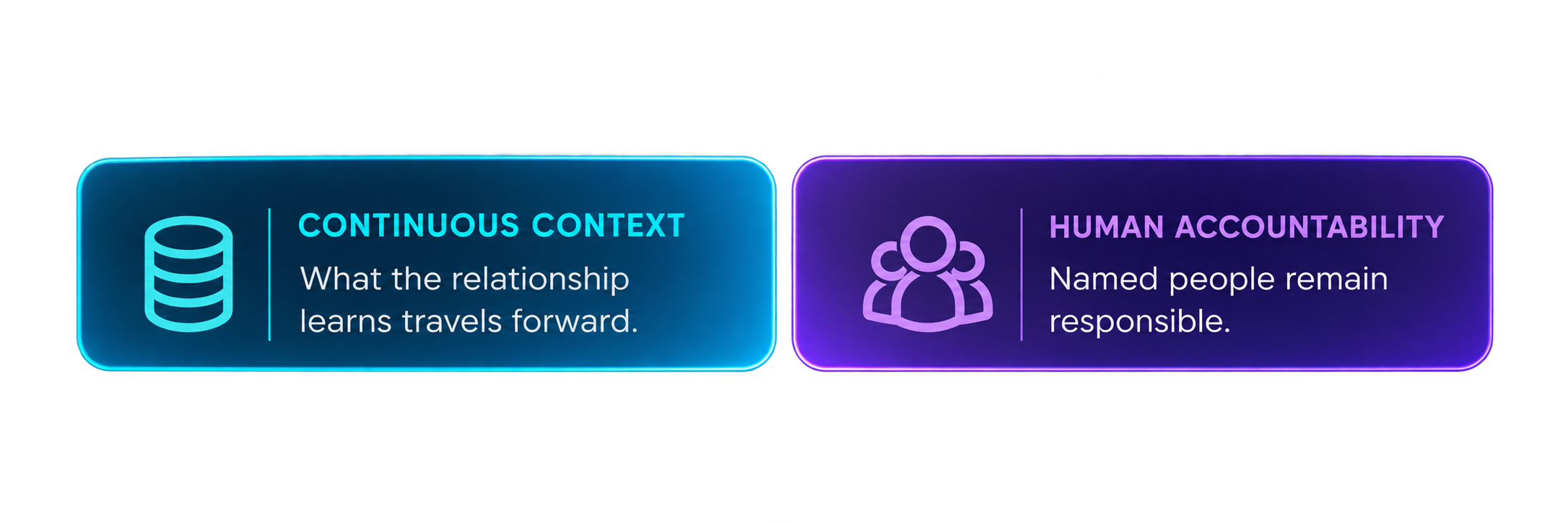
Greater autonomy cannot mean weaker accountability. AI can take on more of the operational work, but named people still define the boundaries, own the controls and remain accountable for what runs autonomously.
You prove the data can be trusted. You prove the workflow behaves as expected. You prove the controls work. Then you expand the boundary.
Here the Five Zeros matter. They are not five isolated AI projects but measurable operational outcomes: fewer avoidable tickets, outages, asset issues and severe breaches, and less wasted investment. Each is a place to test whether greater autonomy produces a better result, and evidence for what should happen next.
The objective is not autonomy for its own sake.
It is the right level of autonomy, backed by the context, evidence and accountability required to keep evolving.
10
01
Question one
What is the ServiceNow AI Readiness Gap?
ServiceNow AI capability is arriving faster than most estates can safely absorb it. The gap is the distance between the two. This section names what creates it, defines it, and sets out how it gets closed.
The barriers
What gets in the way? Silos, untrusted context, disconnected workflows, and people and ownership.
The gap
What exactly is it? The distance between what ServiceNow AI can do and what your organisation can safely let it do.
The road
How does it get closed? Not in one transformation. One bounded Zero at a time, proved in operation.
11
Question one · the barriers
What gets in the way of Autonomous IT?
ServiceNow’s own experience, and what we hear from CIOs, points to the same barriers
repeatedly. The technology can be ready before the organisation is ready to trust it.
01
Silos
Data, teams and technology operate separately.
AI attached to individual solutions recreates the silos it was meant to remove.
The implication
Connect data, AI and workflows through a common platform.
02
Untrusted context
AI cannot reason reliably from data it cannot trust.
Poor CMDB health, fragmented data and inconsistent knowledge reduce confidence in autonomous action.
The implication
Limits the autonomy ceiling and increases risk.
03
Disconnected workflows
Automating an old process is not the same as redesigning the work.
Agents solve isolated tasks. Autonomous IT requires end-to-end workflows that allow AI to interpret context, make decisions and act.
The implication
Don’t automate what you already do. Reimagine the work.
04
People and ownership
Autonomy requires organisational permission, not just technical capability.
Teams need the skills, ownership, controls and confidence to allow AI greater authority, with clear accountability and human judgement where it is still needed.
The implication
Education, upskilling and clear governance unlock autonomy.
Next
Together these barriers set the distance between what ServiceNow AI can do and what your
organisation can safely let it do: the ServiceNow AI Readiness Gap, on page 12.
12
Question one · the gap
The ServiceNow AI Readiness Gap is the distance between what ServiceNow AI can do and what your organisation can safely let it do.
Data, AI & Agents, workflows and governance determine that distance.
Exhibit 01· The execution gap
The gap is not closed by buying more capability. It is closed by making the estate safe to hand it to.
Crossfuze assesses readiness across the foundations of data, AI & Agents, workflows and governance to identify what must change before autonomy can safely increase.
You do not close the gap in one transformation. You close enough of it to act safely, choose a bounded Zero outcome, carry the intent and operating context into controlled change, then prove what changed in operation.
13
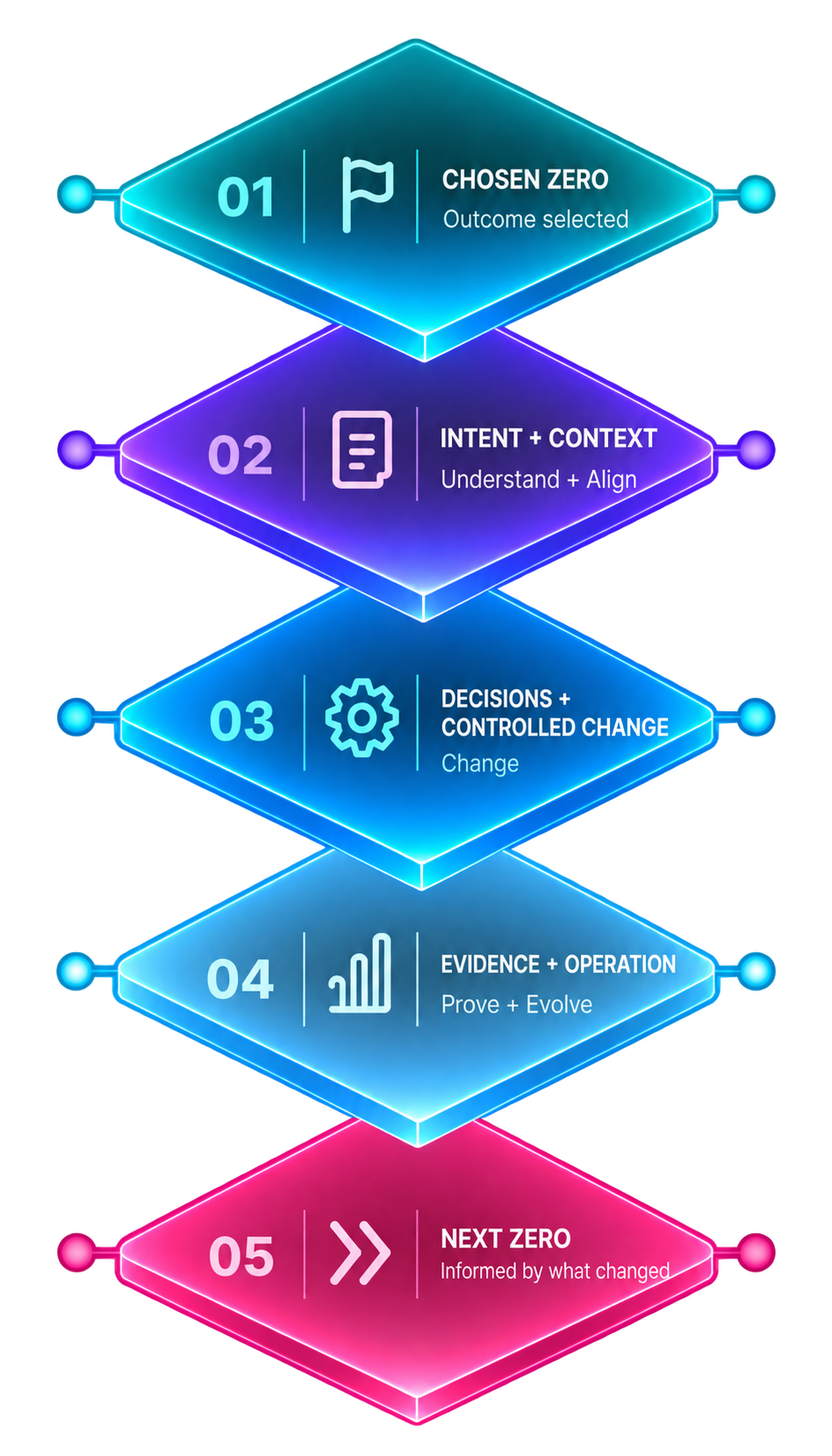
From the readiness gap
Measure readiness
Know where you can safely start.
Assess the estate, the foundations and the current boundary for autonomous action.
Chosen Zero
Outcome selected.
Choose the Zero where business value, operational need and readiness intersect.
Intent + context
Understand + align.
Define the goal, workflow, AI role, measure and authority before anything is allowed to act.
Decisions + controlled change
Change.
Configure, integrate, test and prepare the organisation with the right governance and risk management.
Evidence + operation
Prove + evolve.
Track adoption, value and risk in operation. Prove the outcome and capture what the relationship learns.
Next Zero
Informed by what changed.
Use the evidence to increase permission, extend the workflow or prioritise the next Zero.
Page 12 names the gap. This section measures yours. Readiness is not a feeling. It is evidence about the condition of your estate, the controls around it and what autonomous action can safely be trusted to do.
The estate
What condition is the platform in? CMDB/CSDM, Discovery, service mapping, knowledge, workflow reach and asset data.
The ceiling
How far can autonomy safely extend? Your weakest foundation sets the practical limit.
Your position
Where does that put us today? A stage, an overall readiness score and a score for each foundation.
The permission
What can act, under what controls, and who is accountable? Authority, controls, named ownership, evidence and recovery have to be explicit.
15
Question two · the estate
How ready are you?
ServiceNow’s crawl, walk, run progression gives the direction. Your evidence determines where your estate actually sits on the five-stage path to greater autonomy. Autonomy becomes practical at stage 03.
The readiness journeyAutonomy becomes practical at stage 03
Manually maintained CMDB. Discovery absent or partial. Knowledge written once and never retired.
Discovery running but unmapped. ITSM standardised in places. Automation exists as scripts, not flows.
CSDM-aligned CMDB, service mapping for critical services, Flow Designer coverage, integrations in place.
ITOM correlating events to services. HAM and SAM reconciled. Agentic workflows in production inside limits.
Continuous discovery and remediation. Portfolio decisions fed by live operational data.
Crossfuze readiness scale, with ServiceNow’s crawl, walk, run pacing. The Five Zero outcomes and the Autonomous IT ambition are ServiceNow’s. The readiness scale is Crossfuze’s.
Your ServiceNow estate is the foundation. Data, AI, workflows and governance determine how far autonomous action can safely extend. Named people remain accountable across all four. Read as a decision loop (Sense, Decide and Act) on a Secure governance base, with named human accountability across every stage. Apps and modules are chosen when you choose the Zero, not scored before it.
The same five layers, scoredSense · decide · act→Towards autonomous
01SenseLayer 02
Data
Can you trust your CMDB health and Discovery coverage today?
CMDB/CSDM, Discovery and service mapping provide the context autonomous decisions depend on.
02DecideLayer 05
AI & Agents
Can AI make a grounded decision from trusted knowledge, policy and operating context?
Trusted knowledge, decision logic and relevant operating context ground AI decisions.
03ActLayer 04
Workflows
Does automation reach the systems the process actually depends on?
Standardised workflows and integrations determine how far autonomous action can travel.
04SecureLayer 01
Governance
The base layer
Is every autonomous action bounded, owned and reviewable?
Decision rights, controls, audit, recovery and named ownership determine what AI is permitted to do.
Without itUncontrolled action becomes the risk.
The ruleYour lowest foundation sets the ceiling for every Zero.Your practical readiness stage is determined by the lowest stage reached across the four foundations.
AssistedAgenticAutonomous
Scored from evidence, not opinionCMDB health score · Discovery coverage · Named service owners · Workflow run data · Service management analytics · AI governance records
17
Question two · your position
Illustrative assessment output
Where you actually stand.
The assessment scores the four foundations and places you on the five-stage readiness scale. It returns a stage, an overall readiness score, a score for each foundation and an indicative market position. This is a worked example, not a benchmark for your organisation.
Un-Siloed
Stage 3 of 5 · Walk
You are above the value line, where greater AI adoption becomes practical.
Your estate has the core capabilities in place to start scaling AI, with measurable gains from orchestrating work end to end under governed oversight.
Overall readiness78/100Across the full criteria
Maturity contextAhead of the illustrative midpointContextualised against the stages described in the ServiceNow Maturity Index 2026
Next milestoneAdvanceMove to Stage 4 (End-to-End) by closing the weakest foundation.
Your four foundations
Data Sense
The contextual foundation AI relies on.
3 of 5 in place
Workflows Act
Where the work actually runs.
7 of 12 in place
AI & Agents Decide
The AI and agent capabilities themselves.
6 of 9 in place
Governance Secure
Guardrails, oversight and proof.
4 of 11 in place
!
Current ceilingWorkflows · 58%
Standardise and scale remaining workflows before expanding autonomy further.
Why it matters
Autonomous action can only progress as fast as your weakest foundation.
Benchmark contextCompared with 4,500 executives surveyed
Indicative position based on the ServiceNow Enterprise AI Maturity Index 2026 (19 countries, 12 industries).
Your next move
Close the workflow gap, keep governance above the line, then reassess before expanding autonomy.
Seven controls define the boundary for autonomous action: what can act, what it can touch, who owns it, how it is evidenced and how it can be stopped or reversed. Only 20% of enterprises have implemented AI testing, auditing and risk assessment. Source: ServiceNow Enterprise AI Maturity Index 2026
01
Inventory
What is actually running?
Every agent, model and integration should be discoverable and owned. You cannot govern what you have not found.
02
Risk tier
How much does it matter?
Apply controls proportionate to the potential operational, regulatory and customer impact. Not every use case needs the same level of control.
03
Authority
What may it touch, change or approve?
Define what the agent can access, change, approve and spend, and where a person must decide. Autonomy needs explicit boundaries.
04
Explainability
Can we show why it acted?
Record what the system saw, what it did and the evidence behind the action. If you cannot explain an action, you cannot properly assure it.
05
Exception handling
When does a human take over?
Define when work returns to a person, who owns it and how quickly they must respond. Autonomy needs a designed handover path.
06
Kill switch
How do we stop it?
Provide a controlled way to stop an agent or process immediately. Stop what is happening.
07
Rollback
How do we undo it?
Define how an action is reversed and who owns recovery. Undo what has happened.
Where the controls live
ServiceNow AI Control Tower can provide the inventory, governance and operational oversight layer. Crossfuze then maps the control model to customer policy and recognised frameworks such as NIST AI RMF and ISO/IEC 42001.
One accountable owner. Named service, operations, security and platform stakeholders.
The Q2 answer
You are ready only to the level your weakest foundation and control boundary allow.
Readiness is the intersection of estate condition, autonomy ceiling and permission to act.
19
03
Question three
Where should we start?
Five Zeros. Five different outcomes. The first one should not simply be the biggest prize on paper. Start where business value, ServiceNow readiness and estate fit point to the strongest next move.
The stakes
What is each Zero worth? Each Zero carries a measurable operational outcome. Size the prize before choosing where to start.
The decision
Where should we start? Start where business value is high and the readiness gap standing in front of the outcome is manageable.
The dependency
Why does sequence matter? The Five Zeros share ServiceNow foundations. Work done for one can strengthen what becomes practical next.
The fit
How does our estate change the answer? The same Zero can be an obvious first move for one customer and the wrong starting point for another.
20
Question three · the stakes
What each Zero could unlock.
Each Zero carries a measurable operational outcome. Which to pursue first is the question that follows.
What the numbers mean
These are ServiceNow business-value estimates, not five independently audited customer outcomes. Source: ServiceNow, ‘Autonomous IT: Where zeros make heroes’ · 2026 (vendor-published). ‘Numbers listed are estimates based on known customer outcomes and business value assessment projections. Your results may vary.’ — ServiceNow
21
Question three · the decision
Which Zero should we tackle first?
There is no universal first Zero. Plot each outcome against the value it could create and the readiness gap standing in front of it. Start where value is high and the readiness gap is smallest. Everything else is sequencing, not rejection.
The five Zeros, plotted
01Zero-Touch Support · often an accessible starting point24
02Zero Service Outages · high operational value, deeper engineering dependency25
03Zero Asset Issues · can strengthen shared foundations26
04Zero Severe Breaches · control and governance matter as much as capability27
05Zero Misaligned Investments · potentially high strategic value, dependent on connected evidence28
22
Question three · the dependency
What does the first Zero make easier next?
The Five Zeros share ServiceNow foundations.
Work completed for one can reduce the readiness work required for another. The first Zero is not only an outcome. It also changes the starting position for what comes next.
Shared work that can be reused
Foundation
01Zero-Touch Support
02Zero Service Outages
03Zero Asset Issues
04Zero Severe Breaches
05Zero Misaligned Investments
Governance and action boundariesNamed accountability and a reusable control model, carried forward and revalidated for each Zero.
CMDB, CSDM and DiscoveryTrusted service context: what exists, what it depends on, what it affects.
Knowledge and workflow standardisationStandard paths that make automated resolution and lifecycle actions safe to run.
Asset and service data accuracyHAM and SAM accuracy feeding prioritisation and portfolio decisions.
Sequence the Zeros. Do not run them as five projects.
Choose the first Zero for the value it creates now, then use the shared foundations it builds to improve the starting position for what comes next.
23
Question three · the fit
Which starting point fits your estate?
The same ambition can require a different first move.
Your current ServiceNow estate determines what is credible now. These five common estate starting points show how existing capability changes the best starting Zero, and the enabling work needed to go further.
01
ITSM-led estate
Incident, request and change are on-platform. Knowledge is uneven, with limited automation and little operational context.
SPMSecOpsITOMITAMITSM
First Zerop.24
01Zero-Touch Support
Automate the everyday.
Enabling work
Self-service and knowledge
Data quality and standardisation
Workflow hygiene and integrations
Unlocks next
02Zero Service Outages
03Zero Asset Issues
02
ITSM + emerging ITOM
Core service workflows are established. Discovery and event visibility exist in part, but service context and automation are incomplete.
SPMSecOpsITOMITAMITSM
First Zerop.25
02Zero Service Outages
Predict and prevent disruption.
Enabling work
CSDM alignment and service mapping
Event correlation and noise reduction
HAM and SAM into the CMDB
Unlocks next
03Zero Asset Issues
04Zero Severe Breaches
03
Asset-led clean-up
Asset data is broad but inconsistent. Discovery, HAM or SAM are present, but reconciliation, ownership and trust remain weak.
SPMSecOpsITOMITAMITSM
First Zerop.26
03Zero Asset Issues
Trust what you have.
Enabling work
Data normalisation and reconciliation
Clear ownership and governance
Rationalise tools and processes
Unlocks next
02Zero Service Outages
05Zero Misaligned Investments
04
Security-led estate
Security operations are active, but asset and service context are incomplete. Detection exists, yet response is more reactive than connected.
SPMSecOpsITOMITAMITSM
First Zerop.27
04Zero Severe Breaches
Stop threats earlier.
Enabling work
Asset and vulnerability visibility
Service context for security
Detection, response and automation
Unlocks next
02Zero Service Outages
03Zero Asset Issues
05
Portfolio-led change
Multiple initiatives sit on the platform. Demand, portfolio and resource data exist, but alignment and benefits evidence are weak.
SPMSecOpsITOMITAMITSM
First Zerop.28
05Zero Misaligned Investments
Invest in what matters.
Enabling work
Clear demand and intake
Portfolio and resource transparency
Benefits tracking and value realisation
Unlocks next
02Zero Service Outages
03Zero Asset Issues
Reading the stack
Established capability
Emerging or partial
Not yet in place
24
Question three · the Zero
Zero 01 of 05 What is Zero-Touch Support?
Zero-Touch Support.
Resolve the need before a ticket is raised.
~75%(1)
reduction in Tier 1 ticketsServiceNow estimate
Owned by Head of Service Desk
Today
Every issue becomes a ticket, and every ticket waits for a person.
→
With Autonomous IT
Signals are understood, resolved and learned from without an interaction.
01
What prevents it
Poor knowledge. Fragmented workflows. Missing context at the point of decision. Systems that do not talk to each other.
02
What must be true
Trusted knowledge. Standardised workflows. Integrated systems. Permissions defined before anything acts. Guardrails that hold under volume.
03
Your first move
Find the high-volume, low-risk demand. Separate what needs a human from what exists only because the process says so.
What enables this Zero
ServiceNow capabilities
ITSM · Now Assist · Virtual Agent · Knowledge · Flow Designer · ITOM for true zero
Platform dependencies
Current knowledge · standard request and incident workflows · CMDB context · event and monitoring feeds
How Crossfuze helps
01 AssessKnow where you stand.
Output: Readiness baseline
02 DesignSequence the use cases.
Output: Approved use-case roadmap
03 ExecuteDeploy and run.
Output: Live, governed outcome
What it consumes
Readiness cost
Mostly knowledge content and process standardisation, not engineering. The cheapest of the five to reach, and the easiest to underestimate.
Assist consumption
The highest action volume and the smallest actions: about 25 assists per run against 150 for a wide agentic run. Model the multiplier, not the unit.
Zero-touch is not a faster service desk. It removes the interaction.
25
Question three · the Zero
Zero 02 of 05 What is Zero Service Outages?
Zero Service Outages.
Prevent disruption before it becomes an outage.
70–90%(2)
reduction in mean time to resolutionServiceNow estimate
Owned by Head of Tech Operations
Today
Every alert becomes an outage, and every outage becomes a war room.
→
With Autonomous IT
Signals are correlated, predicted and remediated before service is lost.
01
What prevents it
Unreliable telemetry. Service context nobody trusts. Dependency maps out of date the week after they are built. Remediation that cannot be repeated.
02
What must be true
Trusted service context. Accurate dependencies. Repeatable remediation. Escalation thresholds agreed in advance, not argued during the incident.
03
Your first move
Baseline MTTR, MTTA and MTTD before improving any of them. You cannot prove prevention without knowing what today costs.
Reliable telemetry · CMDB and CSDM alignment · current dependency maps · repeatable remediation
How Crossfuze helps
01 AssessKnow where you stand.
Output: Readiness baseline
02 DesignSequence the use cases.
Output: Approved use-case roadmap
03 ExecuteDeploy and run.
Output: Live, governed outcome
What it consumes
Readiness cost
Telemetry and dependency accuracy make this the most engineering-heavy of the five. The same work raises the ceiling on Zero Asset Issues, so plan them together.
Assist consumption
Fewer events, but correlate-and-remediate is a wide agentic run: nine to twenty tools at 150 assists, against 25 for a narrow one.
MTTR matters less when the incident never happens.
26
Question three · the Zero
Zero 03 of 05 What is Zero Asset Issues?
Zero Asset Issues.
Know every asset: current, connected and trusted.
40–50%(3)
decrease in hardware, software and cloud spendServiceNow estimate
Owned by Head of Asset Management
Today
Every asset class is tracked separately, and the record drifts from reality.
→
With Autonomous IT
One continuously understood estate, discovered rather than declared.
01
What prevents it
A different system and process for every asset class. Lifecycle data that ages faster than anyone can update it, so record and reality drift apart.
02
What must be true
Normalised models. Continuous discovery. Assets mapped to the services they support. End of life visible early enough to plan, not react.
03
Your first move
Start where assets already cause incidents. It is the fastest route to this Zero, and overlaps almost entirely with Zero Service Outages.
What enables this Zero
ServiceNow capabilities
HAM Pro · SAM Pro · Discovery · Service Graph Connectors · CMDB · normalisation
Platform dependencies
Normalised models · continuous discovery · assets mapped to services · contract and lifecycle data in one place
How Crossfuze helps
01 AssessKnow where you stand.
Output: Readiness baseline
02 DesignSequence the use cases.
Output: Approved use-case roadmap
03 ExecuteDeploy and run.
Output: Live, governed outcome
What it consumes
Readiness cost
Discovery and normalisation across asset classes, mostly one-off and largely shared with the outages work. Budget it once, count the benefit twice.
Assist consumption
The lowest ongoing consumption of the five: scheduled reconciliation at the 25-assist end. The return shows up as accuracy on the other Zeros.
You cannot autonomously manage what you cannot reliably see.
27
Question three · the Zero
Zero 04 of 05 What is Zero Severe Breaches?
Zero Severe Breaches.
Contain risk before it becomes a breach.
70–90%(4)
improvement in time to contain a vulnerabilityServiceNow estimate
Owned by Chief Information Security Officer
Today
Every detection joins a queue, and the queue decides what gets investigated.
→
With Autonomous IT
Detections are contextualised and prioritised, so containment starts at the top.
01
What prevents it
Alert volume without context. Exposure data disconnected from the estate it describes. No agreed limits on what autonomous action may do.
02
What must be true
Threat context tied to services and assets. Explicit action boundaries. An audit trail that holds at volume. Rollback is not optional.
03
Your first move
Write down what AI may do without approval before enabling it, then enforce it in AI Control Tower so document and platform agree.
Exposure data tied to the estate · service ownership · action boundaries in writing · an audit trail at volume
How Crossfuze helps
01 AssessKnow where you stand.
Output: Readiness baseline
02 DesignSequence the use cases.
Output: Approved use-case roadmap
03 ExecuteDeploy and run.
Output: Live, governed outcome
What it consumes
Readiness cost
Mostly governance design, not engineering. The expensive part is agreeing boundaries across security, risk and IT, and it cannot be bought.
Assist consumption
Typically 50 assists per enrichment run. The real variable is how much runs without approval, so consumption is a policy decision.
Decide in writing where human authority stays absolute.
28
Question three · the Zero
Zero 05 of 05 What is Zero Misaligned Investments?
Zero Misaligned Investments.
Align strategy, investment and delivery.
50%(5)
increase in projects completed on timeServiceNow estimate
Owned by Head of Strategy and Planning
Today
Strategy says one thing; portfolio, projects and operations fund another.
→
With Autonomous IT
Strategy, investment, delivery and services move as one line of sight.
01
What prevents it
Planning cycles slower than the work they are meant to direct. Application impact nobody can
model. Objectives that live in one system and delivery that lives in another.
02
What must be true
Portfolio decisions tied to live service and asset reality. Roadmaps that move when the evidence moves, not when the annual cycle allows.
03
Your first move
Pick the one investment decision you could not currently defend with data, and work backwards
from it until you can.
What enables this Zero
ServiceNow capabilities
SPM · Strategic Planning · Demand · APM · live ITSM, ITOM and HAM/SAM data
Platform dependencies
Portfolio tied to real service and asset data · application ownership · evidence-led cadence
How Crossfuze helps
01 AssessKnow where you stand.
Output: Readiness baseline
02 DesignSequence the use cases.
Output: Approved use-case roadmap
03 ExecuteDeploy and run.
Output: Live, governed outcome
What it consumes
Readiness cost
Joining portfolio, delivery and service data and changing the planning cadence. The largest organisational cost of the five, the smallest technical one.
Assist consumption
The lowest volume, largest actions: whole-portfolio reasoning spans many tools, so budget 150 assists per run, peaking in planning cycles.
Autonomy without direction is faster execution of the wrong priorities.
29
04
Question four
How do we get there?
Choosing the Zero defines the outcome ambition. Getting there means changing the estate without losing the intent, context and controls that made it worth pursuing.
The route
What does the journey look like? From chosen Zero to trusted outcome, with intent, context and controls carried through into operation.
The key
How is readiness scored? The in-depth AI Readiness Assessment scores seven weighted dimensions before any Zero is designed.
The method
How does Crossfuze get you there? Assess, Design, Execute: a readiness baseline, an approved use-case roadmap, then a live, governed outcome.
The outcome
Is it delivering? Measure what changed after go-live, and use the evidence to decide what happens next.
The licence
Can we afford to run it? Size the ServiceNow tier and Assist consumption to the roadmap, not just today’s usage.
The first step on the Road to ZeroKnow where you stand.A free 90-minute AI Readiness Assessment gives you the readiness baseline every Zero is built on.
30
Question four · the route
From chosen Zero to trusted outcome.
The maturity curve shows where you are. The Road to Zero identifies where to move. The Crossfuze method governs how it is delivered and proved. We carry the intent and operating context into controlled change, then follow it into operation to prove what changed and what comes next.
A STRONGER ESTATE, ONE ZERO AT A TIME.
A clear operational outcome with defined scope and value.
Focused, achievable and aligned to business priorities.
INSIGHTS TRAVEL FORWARD.
Understand the intent, users, processes, data and constraints.
Align stakeholders and define what success looks like.
PEOPLE, PROCESS AND DATA MOVE TOGETHER.
Configure, integrate, test and prepare the organisation for change with the right governance and risk management.
REAL OUTCOMES CREATE WHAT’S NEXT.
Track adoption, value and risk in operation.
Validate outcomes and identify what to improve.
THE NEXT ZERO STARTS HIGHER.
Use what we have learned to prioritise and define the next Zero.
CONTINUOUS THROUGH EVERY STAGE
31
Question four · the key
Every Zero starts with a readiness score.
The Crossfuze AI Readiness Assessment scores readiness separately from opportunity, so a valuable idea in an unready organisation is never mistaken for a safe one. The online version scores the four foundations shown on page 17. The 90-minute in-depth session breaks the same foundations into seven weighted dimensions.
What it scores
Seven weighted dimensions.
01
Data qualityDataReliable fields, records and classifications
20%
02
Process determinismWorkflowsDecisions, exceptions and rollback understood
15%
03
Knowledge and contentAI & AgentsApproved, current content to ground answers
15%
04
Workflow and integrationWorkflowsThe technical estate can run the work end to end
15%
05
Governance and securityGovernanceAccess, approval, monitoring and stop controls
15%
06
Platform and entitlementZero-specific · Estimator, p34Versions, licensing and surfaces fit the plan
10%
07
Ownership and adoptionGovernanceNamed owners, real users, capacity to measure
10%
How a score is built
Scores you can defend
Five anchors, nothing in between. Every score has to be argued.
0None
3Weak
5Mixed
8Strong
10Direct
Findings with a status
Every finding carries one of six states, and its wording matches the state.
Full100% of the weight evidencedProvisionalAt least 80%, including every 20% dimensionUnavailableOtherwise
The score decides what happens next.
Not ready
Fix the foundation first, then reassess.
Ready
Design the use-case roadmap for the chosen Zero.
32
Question four · the method
From chosen Zero to production.
Three stages take you from readiness to a live outcome. Assess where you stand, design the roadmap, then execute through Crossfuze AI Run State (CARS).
AI Readiness Assessment90-min session
Crossfuze AI Run State (CARS)One engagement, two phases
01Assess
Know where you stand.
Score readiness across data, workflows, AI & Agents and governance, and get a clear picture of what your data says.
OutputReadiness baseline
02Design
Sequence the use cases.
Decide which use cases to deploy in the short, medium and long term. Set the autonomy boundary, controls and human approvals.
OutputApproved use-case roadmap
03Execute
Deploy and run.
Build, test and go live, then hand over into run-state ownership. Work runs in 90-day cycles, each proving one bounded outcome before the next begins.
OutputLive, governed outcome
What did the assessment find?
The AI Readiness Assessment shows whether trusted data, fit-for-purpose processes and the right governance are in place.
Not readyFix the foundation first.
Address core dependencies so the outcome can be delivered and sustained.
Data
AI & Agents
Workflows
Governance
Reassess, then continue to Design.
ReadyMove to Design.
Sequence the use cases, then execute through CARS.
02Design
OutputApproved use-case roadmap
03Execute
OutputLive, governed outcome
Hand over into run-state ownership.
33
Question four · the outcome
Go-live is a threshold. Not the finish line.
Go-live delivers capability. Operation proves the outcome. Measure what actually changed, use the evidence to decide what happens next, and keep learning in operation.
Success looks different for each Zero
Service Desk
Zero-TouchSupport
Tier 1 tickets~75%↓Effort per incident66%↓Fully automated services20%
Tech Operations
Zero ServiceOutages
MTTR70–90%↓Critical outages58%↓Incidents auto-remediatedup to 95%
Containment time70–90%↓Unaddressed critical vulnerabilities10%↓Security incident close time50%↓
Strategy & Planning
Zero MisalignedInvestments
On-time projects50%↑Demand aligned to strategy90%Resource allocation cycle50%↓
Achieved outcomeKPI target example
ServiceNow business-value estimates and published customer outcomes (sources, page 37). Customer outcomes are not guaranteed; KPI targets require an agreed organisational baseline.
34
Question four · the licence
Three packages. AI in every tier.
No separate purchase. No add-on SKUs. Existing SKUs reached end of sale on 1 July 2026, so the tier you renew on has to fit the Zero you are heading for.
ServiceNow · 9 April 2026
Foundation
AI to assist with work
OOTB GenAI Skills & AI Agents
Summarisation
Pattern recognition
Categorisation
Task-based assistance
Typical todayStandard / Pro
Advanced
AI to accelerate workflows
OOTB Agentic Workflows
Understands context
Applies domain knowledge
Automates an entire process
Typical todayPro Plus / Enterprise
Prime
AI to deliver autonomous outcomes
Build Custom AI Specialists, Agents & Skills
Fully independent
Makes decisions
Role-based expertise
Typical todayEnterprise Plus
ASSISTEDAGENTICAUTONOMOUS
Across all tiersMoveworksWorkflow Data FabricAI Control TowerProcess Mining*
Four questions to answer before you renew.
Before signing
01
Capability
Does the tier support the AI the chosen Zero needs?
ITOM and CSM have no Foundation tier. Advanced is now the minimum.
02
ConsumptionEstimator
What will the planned workflows consume at scale?
Heavy AI use burns the Assist pool 12× faster than light use.
03
EntitlementEstimator
Does the included Assist allocation cover that demand?
Assists and Data Fabric credits are separate meters. Model both.
04
Renewal
Are tier, entitlement and overage agreed before you sign?
Remove bundled legacy line items and lock top-up pricing in writing.
* Process Mining included in Advanced and Prime only. Source: ServiceNow New Commercial Model Overview, April 2026.Edition 2026
35
The checklist
Four questions. Ten checks.
Autonomous IT is not a technology decision alone. It is a readiness, control and outcome decision. Four questions frame this guide. These ten checks answer the last three.
01
What is the ServiceNow AI Readiness Gap?
The starting point · pages 10–13
02
Are we ready for Autonomous IT?
Clarity before commitment
Check 01
What are we actually prepared to let AI do without a human in the loop?
Define the boundary of autonomous action, what remains human, and where risk is unacceptable.
Check 02
Can our ServiceNow estate give AI context we would trust in production?
AI needs current, connected and reliable data, knowledge and service context to act accurately.
Check 03
If AI makes the wrong decision, can we see why, stop it and recover?
We need explainability, controls, monitoring and a clear rollback path.
Check 04
Where is our weakest readiness foundation today?
Score the four foundations set out on page 16. The lowest one sets the practical ceiling.
03
Where should we start?
Focus for impact
Check 05
Which Zero solves a problem the business already cares about?
Start where there is real operational pain and a clear, measurable outcome.
Check 06
Which ServiceNow capabilities can our current estate actually support?
Match ambition to what is practical with your platform, integrations, licence tier and data today.
Check 07
Can we prove the outcome in operational data?
If you cannot measure the before, the change and the result, you cannot credibly claim the Zero.
04
How do we get there?
From ambition to action
Check 08
What is stopping greater autonomy today?
Is it data quality, fragmented workflows, missing ownership or weak controls?
Check 09
How much autonomy is enough?
The goal is not maximum autonomy. It is the highest level that can be safely operated, evidenced and governed.
Check 10
What can we prove in the next 90 days?
Choose one bounded outcome where greater autonomy can be tested, measured and improved under control.
36
Take the first step
Start your Road to Zero today.
Two ways to begin. Both are free, and both give you the readiness baseline every Zero is built on.
Source: ServiceNow, “Autonomous IT: Where zeros make heroes,” 2026 (vendor-published). “Numbers listed are estimates based on known customer outcomes and business value assessment projections. Your results may vary.”
(1)
Zero-Touch Support: ServiceNow estimate, ~75% reduction in Tier 1 tickets. Related: EY reports 75% reduction in overall service ticket volume across 1M+ tickets/year, 30 service desks (customer-reported; measures total volume, not Tier 1 specifically).
(2)
Zero Service Outages: ServiceNow estimate, 70–90% MTTR reduction. Related: Flight Centre Travel Group reduced MTTR by 80%, incidents by 50% (customer-reported; same metric).
(3)
Zero Asset Issues: ServiceNow estimate, 40–50% reduction in hardware/software/cloud spend. Related: Community Health Systems (with ServiceNow/KPMG) reports 40% savings in licence true-up costs, 95% of assets auto-tracked (customer-reported; narrower metric: licence true-up, not total spend).
(4)
Zero Severe Breaches: ServiceNow estimate, 70–90% improvement in containment time. Related: ServiceNow Now-on-Now reports 85% reduction in security incident close time (vendor’s own result; measures closure, not containment).
(5)
Zero Misaligned Investments: ServiceNow estimate, ~50% increase in on-time projects. Related: MKS Instruments reports 30% increase in on-time projects: same metric, named customer, lower result. ServiceNow SPM guidance cites 30% as a representative customer KPI.
ServiceNow Enterprise AI Maturity Index 2026 pp. 17–18
Source: ServiceNow, “Enterprise AI Maturity Index 2026,” Workflow, 9 June 2026. Survey of 4,500 executives across 19 countries and 12 industries. servicenow.com/workflow/ai/enterprise-ai-maturity-index-2026.html. Basis for the benchmark context on page 17 (compared with 4,500 executives surveyed) and the finding on page 18 that only 20% of enterprises have implemented AI testing, auditing and risk assessment. The position on page 17 is an illustrative assessment output.
Autonomous IT and the five Zeros p. 4
Sources: ServiceNow Workflow, 1 July 2026 · AI Summit Oslo, 18 June 2026, and Zurich, 2 July 2026 · World Forum New York, 10 September 2026. Insight, Automation and Autonomy are ServiceNow’s Autonomous IT ServiceOps phases, 5 May 2026, published against Zero Touch IT Support and Zero Service Outages; applying them across all five Zeros and across both tracks is Crossfuze’s reading.
Assist consumption pp. 24–28, 34
Source: ServiceNow assist-consumption guidance, 2026. An agentic run using 0–4 tools consumes 25 assists, 5–8 tools 50 assists, and 9–20 tools 150 assists. The “12× faster” pool burn at heavy agentic use compares 150 with 25 assists per run and follows Crossfuze’s published pricing guidance.
Packages and licensing p. 34
Source: ServiceNow New Commercial Model Overview, April 2026. Process Mining included in Advanced and Prime only.
38
Every step toward zero
Every step toward zero is capacity returned to the team.
Not people-free. Friction-free.
Autonomous IT is where it starts. The confidence to keep evolving is what it is for.
Autonomous IT and the Five Zero outcomes are ServiceNow’s and are attributed throughout. The Road to Zero is Crossfuze’s practical guide to pursuing them. Crossfuze helps you understand where you stand against
them, what stands in the way, what the climb will consume, and where to move first.